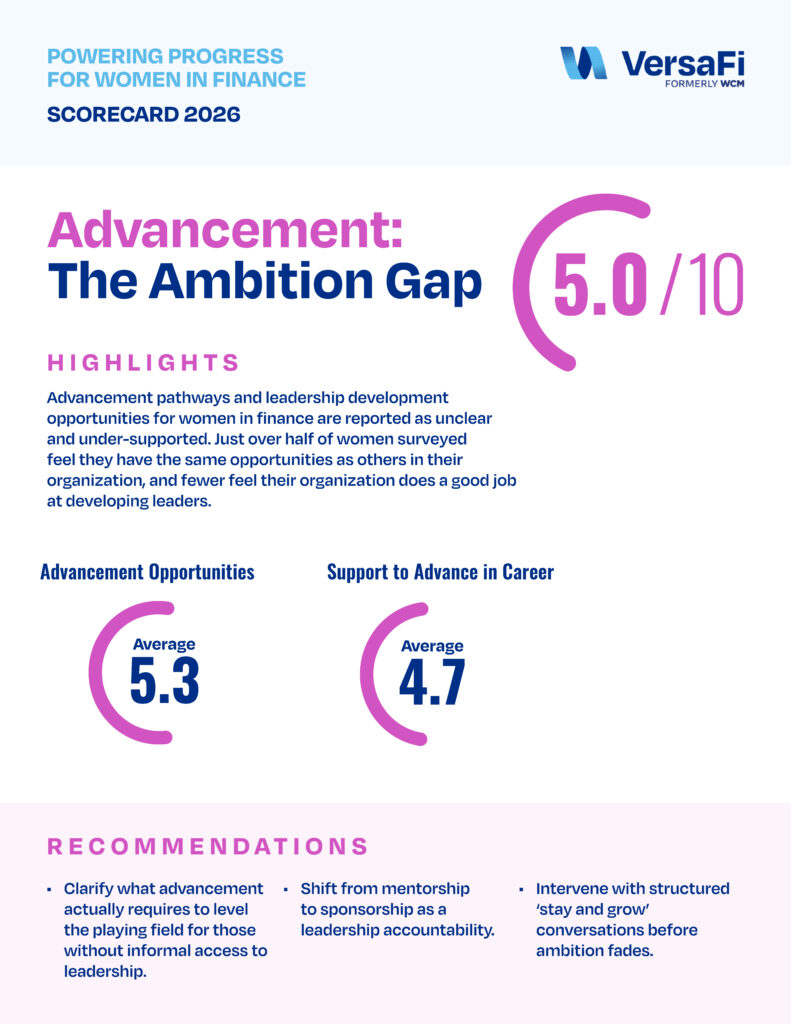
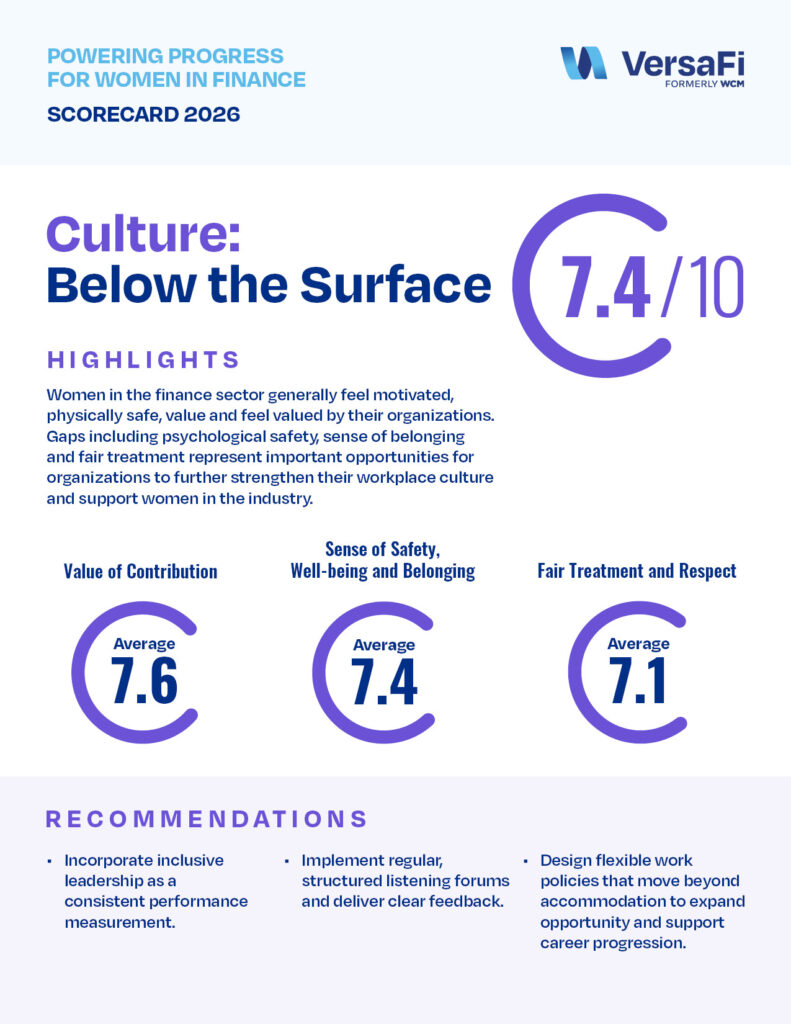
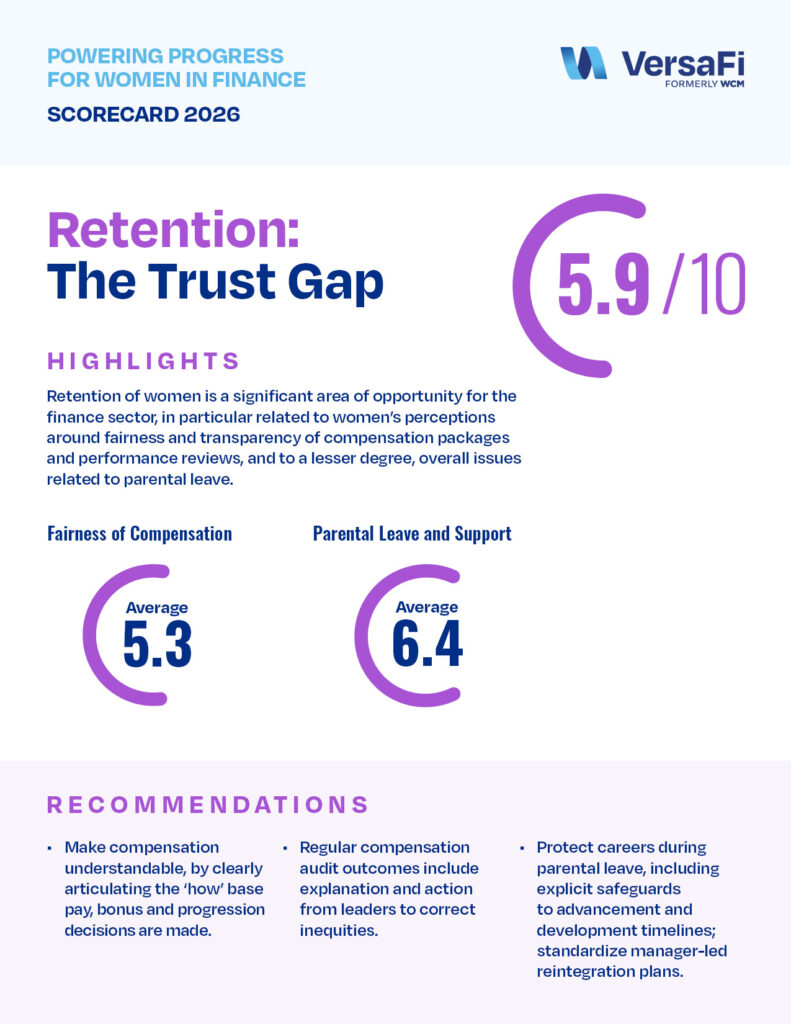
Advancement, Culture, Retention, Women in Finance

Powering Progress for Women in the Finance Sector – Scorecard 2026

Powering Progress for Women in the Finance Sector – Scorecard 2026

The Canadian finance sector continues to navigate a challenging and complex landscape in addition to rising customer expectations. 

The finance sector is at the very heart of Canada’s economic growth and stability with attracting, advancing and retaining talent ever more urgent. Women are an integral part of the sector’s mission-critical talent equation, yet they remain significantly underrepresented in key roles, and often overlooked for advancement opportunities. 

VersaFi conducted an in-depth study of women across diverse finance roles, exploring both progress and persistent challenges in three key impact areas: Culture, Retention, and Advancement. Our inaugural Powering Progress Scorecard is designed to address these critical questions: why are the majority of women in finance falling short of achieving the careers to which they aspire? Has their collective ambition changed? What is holding them back?
Want to learn more?

Related Insights & Analysis (Research)

Gender parity
Women on Boards: Global Trends in Gender Diversity on Corporate Boards

Research conducted for this report state that companies with women in strong leadership positions generate a return on equity of 10.1% per year vs. 7.4% without. The MSCI uses this business case to make the argument that quotas are necessary to reach the goal of 30% female representation in a timely manner.

Gender parity
Women Matter: Ten years of insights on gender diversity

In 2017, McKinsey & Company surveyed 233 companies in nine Western European countries to measure progress made towards equal gender representation. They found great interest in gender diversity, but lacklustre results. The report notes that bridging the gender gap in Europe could add USD 2 trillion to the GDP by 2025.

Gender parity
Women in the Boardroom - 7th edition

This Deloitte report provides a comprehensive look at both the global efforts made to increase board diversity, and the progress made to date. The research scans 6 continents, over 60 countries, and over 7,000 companies. Findings are divided by region and country, and include industry variations.